
Bathroom Brands vs 'True' Manufacturers: What’s the Difference?
What is a manufacturer? Modern Bathroom Brands . Compare the global white-label sourcing model against 'true manufacturing'
NEWS
6/5/202611 min read
Bathroom Brands vs. 'True Manufacturers': What Are You Actually Buying?
When you step into a premium showroom or browse online for a new bathroom vanity unit, you are met with an endless sea of stunning imagery. Sleek handleless designs, beautiful fluted textures, and pristine mineral basins dominate the landscape. Almost every brand proudly attaches the word "manufacturer" to its identity.
But if you peer behind the marketing curtains of the UK bathroom industry, it turns out that the term actually covers two completely different business realities.
On one hand, you have a strict legal definition of a manufacturer—a trade framework that allows companies to claim the title based purely on branding, even if they don't physically build a thing. On the other hand, you have a manufacturer in its purest form—a brand that rejects third-party factories entirely to engineer, construct, and control every single component under its own roof.
As a consumer planning a bathroom renovation, it’s fascinating to look at how this impacts your project:
When a brand calls itself a manufacturer, what are you actually paying for?
How do these different production methods impact the longevity of a vanity unit inside a damp, high-humidity home environment?
Does true in-house engineering still matter, or has global outsourcing levelled the playing field?
This guide takes a closer look at the inner workings of modern bathroom production, cutting through the showroom jargon so you can see exactly how the industry works and make an informed decision for your project.
The Two Faces of Modern Bathroom Production
To understand where your bathroom furniture comes from, we have to look at the two primary business models operating across the globe. Neither path is right or wrong, but they offer vastly different levels of oversight, design continuity, and component control.
Model 1: The Global Sourcing & White-Label Route
Let us begin with the model that effectively powers a vast portion of the modern retail landscape. Today, many household bathroom brands act primarily as designers, curators, and logistics experts rather than a pure manufacturer.
In this scenario, a brand may follow this path:
Design or Selection: The brand’s UK team identifies hot market trends—such as the massive demand for fluted wood finishes or Japandi styling. They either design a concept on paper or browse existing catalogue designs offered by independent factories.
The Factory Partnership: The brand partners with large-scale, independent manufacturing facilities located in global hubs like China, India, or Turkey.
The White-Label Agreement: These independent factories agree to produce the furniture. They might manufacture the exact same cabinet chassis for three or four different global brands, simply changing the outer fascia, the branding plates, or the handles.
Importation & Distribution: The items are branded, packed, loaded into sea containers, imported into the UK, and distributed to retailers. Presto—you have a bathroom brand.
There is a practical place for this method in our interconnected global economy. Technical capabilities, machinery, and quality control systems within international contract factories have advanced significantly. They produce stylish, accessible products that allow the wider market to react quickly to changing high-street tastes.
Model 2: The Vertically Integrated 'True Manufacturer'
On the other side of the coin sits the traditional, vertically integrated manufacturer—the role in its absolute purest form. This is a brand that rejects the third-party outsourcing model entirely, choosing instead to keep the entire lifecycle of production inside their own physical facilities.
When a brand is a true manufacturer in the purest sense, they own and manage the entire infrastructure. In this closed-loop ecosystem, every element of the factory floor is customised with only one thing in mind: their own specific brand.
Dedicated Production Lines: The assembly lines never switch between competing brands. Every machine operator, quality inspector, and engineer is an expert in that specific brand's technical specifications.
Tailored Machinery and Tooling: The massive automated saws, edge-banders, and drilling rigs are permanently calibrated and physically set up for the exact dimensions, weight tolerances, and joint types of that brand's unique furniture ranges.
Proprietary Technical Programming: Every 3D design file, CAD/CAM drawing, and automated machine code is written by in-house software engineers. There are no generic templates; every cut is completely bespoke.
Micro-Level Quality Control: Because they control the facility, they control the smallest components. Every single nut, bolt, dowel, bracket, and drawer runner is specified, stress-tested, and audited internally. Nothing is left to the changing stock levels or substitutions of an outside supplier.
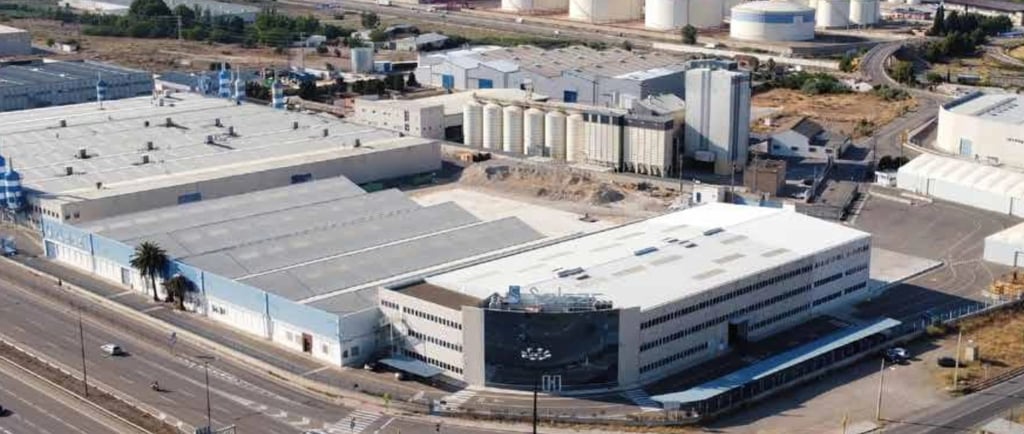
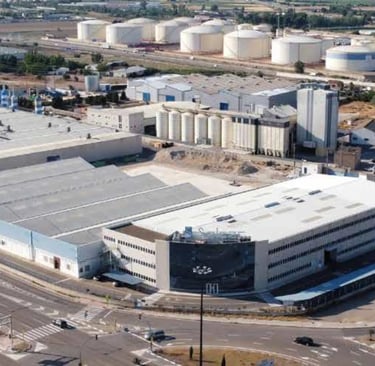
Salgar dedicated factory in Zaragoza ,Spain
Salgar has been crafting high-quality bathroom furniture since 1947. As a family-owned business, they take pride in their craftsmanship. Every piece reflects decades of expertise and a passion for design.



The Legal Blueprint: How Trade Law Works
To understand the first face of the industry—the official legal definition—we have to look closely at the regulatory fine print governing product safety and consumer goods. Here is how product compliance trade laws actually work in the UK and Europe.
If you do not own the factory or the machinery, how can you define yourself as a manufacturer?
In everyday language, we think of a manufacturer as the person physically cutting timber or running an assembly line. However, UK and European product safety laws look at it differently. According to the statutory trade frameworks detailed in the European Commission Blue Guide on Product Rules, a business does not need a physical assembly line to hold the title.
Under these regulations, businesses are categorised into roles known as Economic Operators. The official definition states that a manufacturer is any natural or legal person who manufactures a product or has a product designed or manufactured, and markets that product under their name or trademark. Because an importer puts their own name on the final product, the law officially classifies them as the manufacturer.
Does outsourcing production excuse a brand from legal liability?
Absolutely not. Not owning the building does not grant an escape clause from safety laws. In fact, it does the exact opposite.
The moment a bathroom supplier stamps their own logo onto a white-label vanity unit produced abroad, they instantly take on the exact same legal responsibilities as if they owned the physical factory floor. The physical birthplace of the furniture becomes completely irrelevant. As outlined in the UK Product Safety and Metrology Enforcement Guidelines, they shoulder 100% of the legal liability for the product's safety, engineering compliance, and long-term structural integrity.
How does this re-badging process work in the real world?
A clear parallel that any homeowner will recognise can be found in designer central heating radiators.
If you browse Amazon or even a high-end interior design website and buy a trendy, dark anthracite vertical column radiator branded under a brand name, that company probably didn't smelt the steel.
The boutique brand simply selected a standard radiator core from a massive global original equipment manufacturer (OEM), chose a specific powder-coated colour finish, and had their own brand plate riveted to the side. Under UK trade and safety laws, that brand is the sole legal "Manufacturer." If a weld splits and floods your home, they hold full legal accountability; they cannot pass the buck to the overseas foundry.
What actual responsibilities must an importer fulfil to use this title?
Because they take on full manufacturer status, a white-label bathroom brand cannot simply trust a box of certificates sent over by a third-party factory. They are legally compelled to maintain a comprehensive safety and quality infrastructure, which includes:
Risk Analysis: Conducting and documenting deep safety and environmental assessments of the furniture.
Technical File: Keeping a secure, highly detailed file of the product's complete engineering specifications and construction layout.
Factory Production Control: Demonstrating active, continuous monitoring of the manufacturing quality control standards.
Declaration of Conformity: Signing an official, legally binding document stating that the product meets all applicable UK and European safety regulations.

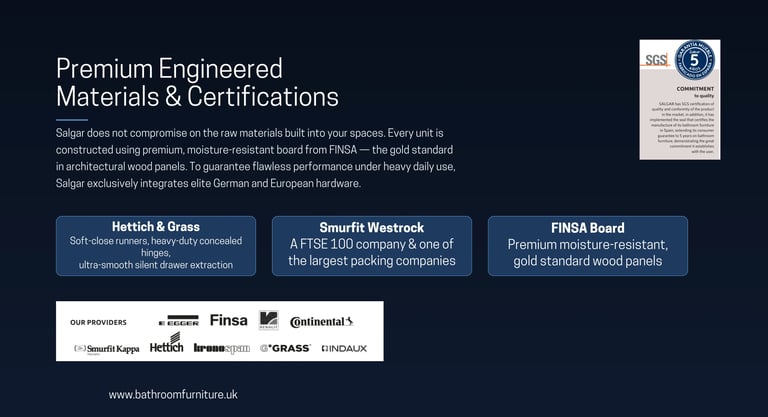
A look at the scale and accreditations from one of the bathroom industry's leading 'true manufacturers' Salgar
The Raw Material Frontier: Premium Partners & Sourcing
When evaluating a true manufacturer, you must look beyond the legislative paperwork to where the physical journey actually begins: the sourcing of raw materials. A true manufacturer does not just buy generic timber off the open market or look for the lowest bidding hardware vendor. Instead, they establish deeply integrated, long-term relationships with premium, globally respected industry partners.
Sourcing Sustainable Timber
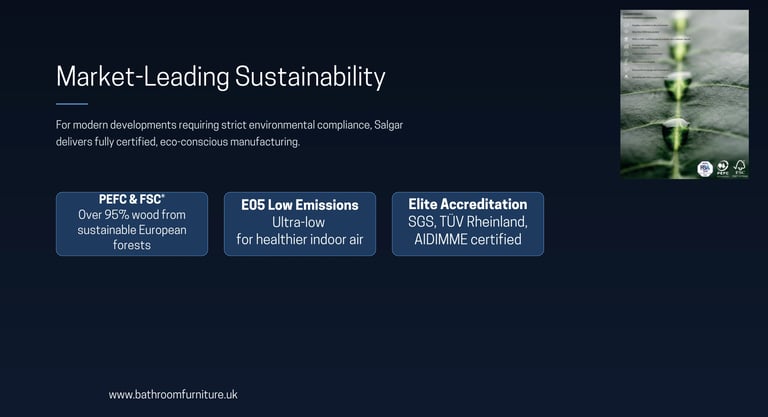
Bathroom furniture is predominantly crafted from engineered wood, such as Melamine Faced Chipboard (MFC )or Medium-Density Fibreboard (MDF) . Because true manufacturers control their own intake, they can strictly mandate that 100% of their wood supply comes from certified, sustainable forestry.
By working with premium European timber mills, they ensure that the raw components are fully traceable, reducing environmental strain while guaranteeing that the wood possesses the exact structural density required to resist bowing and structural fatigue in damp rooms.
Respected Engineering Partners
A beautiful cabinet door or drawer front is only as reliable as the hidden mechanical components holding it together. True manufacturers ensure longevity by integrating elite hardware from world-renowned technical specialists.
For example, smooth movement and lasting durability are achieved by using runner and hinge systems from globally respected brands like Hettich and Grass. These high-end components are certified to handle substantial weight loads (often up to 40kg) and feature advanced fluid-damping technology for a silent, soft-close action that lasts for decades.
Environmental Stewardship & Ethical Manufacturing
Authentic manufacturing isn't just about what happens inside the factory walls; it is about a brand's footprint on the wider world. True manufacturers like Salgar often take a proactive, holistic approach to environmental responsibility.
Circular Production & Recycling
Because a true manufacturer owns the entire facility, they can implement highly sophisticated waste-reduction strategies. Modern plants are designed to operate as circular ecosystems:
Wood offcuts and sawdust from CNC routing lines are captured via automated extraction systems and repurposed to generate clean biomass energy to heat the facilities.
Finished furniture ranges are engineered to be highly recyclable at the end of their lifecycle.
Packaging is continually overhauled to phase out single-use plastics, replacing them with 100% recyclable, cardboard-based protective structures.
Indoor Air Quality: The E05 Standard
Environmental care also extends directly into your home. Lower-tier imported furniture often utilizes cheap adhesives that release high levels of formaldehydes into the air over time.
True manufacturers protect the consumer by ensuring all boards comply with the incredibly strict E05 quality standard. This production standard updates the historical European baseline via the EU REACH Restriction on Formaldehyde Emissions, guaranteeing an exceptionally low emissions profile to keep the air inside your home clean, safe, and completely toxin-free.
Why True Manufacturing Matters for the British Bathroom
A bathroom vanity unit is subjected to some of the harshest conditions of any piece of furniture in your home. Unlike a bedroom wardrobe or a living room sideboard, a bathroom cabinet must endure wild temperature fluctuations, direct water splashes, and high levels of ambient steam and humidity day after day.
This is where the benefits of a true manufacturer become highly apparent. When a company owns the factory, they can invest heavily in specialised, proprietary manufacturing technologies that protect furniture against moisture damage—innovations that are incredibly difficult to implement through standard white-label factory sourcing.
The Salgar Standard: Masterclass in Spanish Engineering
A prime example of this uncompromising approach to production is the European brand Salgar, a name completely dedicated to the highest manufacturing principles. As highlighted on Bathroom Furniture UK's Salgar Biba Collection Guide:
"Salgar, a family-owned business, has been a trusted name in the bathroom furniture industry for over 70 years... Their dedication to craftsmanship is evident in every product they create."
Founded in 1947, Salgar does not outsource their furniture production to generic third-party facilities. Instead, they handle 100% of their manufacturing inside their own state-of-the-art complex in Zaragoza, Spain.
As detailed in the official Salgar Corporate Presentation Portal, they operate a vast facility spanning up to 50,000 square metres of constructed factory and warehouse space, churning out roughly one million units a year. Salgar treats furniture manufacturing as a science. Because they control every square foot of the factory floor and source only the finest raw components, they have engineered specific, high-performance solutions that elevate their ranges:
Advanced 3D Moisture-Resistant Barriers: Moisture is the ultimate enemy of engineered wood materials like MDF. If steam penetrates the outer layer, the wood swells and the surface peels. Salgar prevents this by running their own specialised ultraviolet (UV) curing and lacquering lines. Ranges like Monterrey and Uniiq feature advanced 3D protective finishes specifically designed to withstand the damp, high-humidity environment of a busy bathroom.
Premium Onix Interiors: True manufacturing allows for unique, brand-wide design cohesion. Salgar finishes their premium drawer interiors with their sleek, highly durable Onix linings. It ensures that the inside of your furniture is just as visually stunning, water-resistant, and easy to clean as the exterior lacquer.
Millimetre-Perfect CNC Joinery: When software programs talk directly to the cutting machinery on a dedicated line, the structural joints of the furniture are incredibly tight. This structural rigidity ensures that drawers remain perfectly square and aligned, even after years of opening and closing.
Direct Supply Chain Integrity: When a brand relies on multi-client global factories, they are at the mercy of international shipping congestion, raw material shortages, and production delays. Because Salgar manages their own factory schedules, they maintain regular, direct transport links from Spain straight to their dedicated UK distribution subsidiary and warehouse hub in Birmingham. This ensures consistent stock availability for UK showrooms and homeowners.
Accreditations: The Ultimate Proof of Quality
A truly authoritative manufacturer backs up their engineering claims with rigorous testing from international, independent certification bodies. These standards can be fully cross-referenced and tracked via the British Standards Institution (BSI) Compliance Standards Knowledge Base:
Accreditation BodyWhat They Test and Certify SGS Seal Verifies structural safety, vertical load resistance, and sudden drawer-opening durability.TÜV Rheinland Assesses rigorous product safety, material health, and manufacturing consistency.AIDIMME Evaluates specific laboratory performance for wood, coating and furniture durability in environmental and climate chambers.European Community (CE)Ensures compliance with all relevant European health, safety, and environmental protection legislation.
These rigorous standards—such as BS EN 14749 (specifying safety requirements and test methods for domestic, kitchen and bathroom storage units) and BS EN 15338 (vetted strength and durability criteria for extension elements/drawer runners)—ensure that the cabinet hanging brackets won't buckle under the weight of a heavy ceramic basin, and that the drawer runners won't fail after a few thousand uses.
Frequently Asked Questions
Q: Is an outsourced bathroom product inherently lower quality?
A: Not at all. Modern contract factories use incredible technology, and the brands partnering with them deliver fantastic products. The real difference isn't about safety or basic reliability—it's about customisation. With an outsourced brand, you are generally buying a beautiful design adapted to a standard factory template. With a true manufacturer, you get a piece of furniture where the inner mechanics, materials, and moisture protections have been built from scratch exclusively for that specific range.
Q: Do sourcing brands offer the same level of consumer protection?
A: Absolutely. UK trade standards ensure that any brand putting their name on a product plays by the exact same strict safety and quality rules as a physical factory. Because they hold full, non-transferable responsibility for the product, they carry out rigorous quality checks. As a consumer, you get the exact same robust legal protection and peace of mind regardless of where the assembly line sits.
Q: What makes raw material sourcing so critical in a bathroom?
A: It all comes down to humidity. Lower-grade timber boards have inconsistent fibres that can swallow up airborne moisture, causing the wood to expand and knock your doors out of alignment over time. Premium, strictly vetted timber boards resist this movement entirely, keeping the unit completely stable in a steamy room.
Q: How can I tell if a brand is a true manufacturer or a sourcing brand?
A: It usually comes down to how they talk about their process. True manufacturers are incredibly proud of their facilities, so they will actively show you their factories, talk about their machinery, and highlight proprietary features like Salgar’s Onix drawer interiors.
Q: Does choosing a true manufacturer mean I will pay significantly more?
A: Not necessarily. Because vertically integrated manufacturers manage the entire pipeline under one roof, they cut out third-party factory markups, middlemen, and fragmented shipping costs. This efficiency allows brands like Salgar to offer top-tier European engineering at highly competitive price points.
Elevating Your Expectations
The modern evolution of the supply chain is brilliant news for British homeowners. The fact that brands can source globally keeps the UK bathroom market highly competitive, accessible, and overflowing with beautiful design options for every budget. There is no reason to look down on this route; it keeps the high street vibrant and ensures consumers are fully protected by excellent modern standards.
But when you are planning a space to stand the test of time, there is an undeniable magic in going back to the roots of the craft. Choosing a true manufacturer like Salgar isn't about avoiding a bad product—it's about choosing total design integrity. It is the lasting satisfaction of knowing that from the first 3D design file to the final lacquer coat, your furniture was purposefully imagined, engineered, and 100% catered for your home by a single dedicated team.
Contact Us Today
For all enquiries about Salgar products ,to place an order or to discuss becoming a premium partner retailer contact us today.